

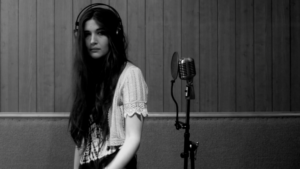
BadPuss: A Popumentary undresses female stardom to reveal a hypersexualized culture of young, misguided girls.
A story that mirrors today’s Hollywood headlines, the film follows BadPuss—an all-girl band whose rise to fame thrusts them into a hedonistic, raucous culture, followed by a painful fall.
The film reflects pop stardom through a funhouse mirror. Lara Reares, the creator of BadPuss, attempts to reunite the band for a comeback tour—but time has passed, resentments have grown, and dark truths have surfaced.
Documenting the revival is a desperate reporter following Lara, Kassie, and Ro just two days before their comeback tour, Body Shots and Hot Regrets, begins.
A Glittering Collapse
The film is a wild ride—propelling itself into whimsical stardust before plunging into chaos through the often hilarious and tragic misadventures of three women trying to survive contemporary pop culture.
It is not a cautionary tale, but rather what writer/director Emily Wiest calls a “grand fantastical tragedy.”
“If there is a message,” she says, “it’s a byproduct of the struggle.”
Wiest threads dark humor through serious subject matter. The audience laughs—until the reality of excess, recklessness, and self-destruction hits. And then the laughter shifts.
Pop Culture Mirror
We’ve seen it before.
Britney Spears shaving her head in a moment of crisis. Miley Cyrus swinging naked on a wrecking ball, courting controversy and attention.
We laugh, we judge, or we rally behind them. But beneath it all is a more difficult question:
What is truly funny about a young woman in distress—searching for identity, autonomy, or simply the ability to breathe?
A Storyteller’s Origin
The daughter of Oscar-winning actor Dianne Wiest, Emily grew up surrounded by storytellers.
“I’m a storyteller,” she says. “The first book I ever wrote was called Long Knowits, and I was three. Sadly, it has yet to be published.”
She recalls growing up backstage in theaters, immersed in drama:
“If you spend a summer crouched in the dark listening to Oedipus and Salome over and over… you begin to understand extremes—the highs and the lows. It becomes part of you.”
The Cast
Actress Sydney Lemmon is the granddaughter of Jack Lemmon. Asia Ashford, another cast member, is the daughter of music legends Ashford & Simpson. Hannah Sorenson, by contrast, comes from North Dakota, the daughter of an artist.
“I think the biggest gift we share is that our parents understand the need to create,” Wiest says. “That kind of support frees you.”
Independent Spirit
The cast raised $28,000 on Kickstarter—$3,000 over their goal—from 190 backers.
No industry favors. No shortcuts.
The BadPuss website features behind-the-scenes footage, including set design and interviews with musician Jon Barber Gutwillig of the Disco Biscuits, who composed the film’s music.
On Set
I interviewed Wiest, Lemmon, and Sorenson in the kitchen of a photographer friend’s apartment as they prepared for a shoot.
Janis Joplin blasted from the next room while Wiest slipped into character. Lemmon stretched on the floor, coffee in hand, while Sorenson transformed into a glittering pop star.
Their camaraderie was immediate and genuine. They spoke openly about the challenges of being new in the industry—building résumés, finding work, making ends meet.
Collaboration
Wiest credits the success of the film to collaboration.
When doubt crept in, it was her team that grounded her.
Producer Karli McGuiness describes the process:
“As a filmmaker friend warned us, ‘A lot of pre-production is putting out fires.’ To that we say—we are fearless firefighters.”
Wiest adds: “Karli McGuiness is the fearless firefighter. She lived up to it every day.”
Building the World of BadPuss
“People just fell into the project,” Wiest explains. “It started with friends and expanded organically.”
Designer Claire Deliso—trained in theater and raised in the French countryside—created bold, sensual sets and costumes.
Wiest recalls her favorite moment:
“Nipples! We must have more nipples!” (in a slight French accent).
Music & Energy
Music drives the film’s pulse.
Composed by Jon Barber Gutwillig, the soundtrack evolves alongside the band’s trajectory—from rock ballads like Chain Me to Your Twin Bed College Boy to club tracks like Ketamine Santa.
The cast contributed vocally, alongside a diverse group of musicians.
Performances
Wiest emerges as a powerful voice—both as writer and performer.
Hannah Sorenson’s portrayal of Kassie is especially compelling:
“A walking heart with legs,” she says.
Her character embodies innocence and distortion—raising important questions about how young women are sexualized in media.
Fame & Fragility
The film also reflects the audience—the fans.
Young girls who idolize pop stars, projecting devotion through screens. When the idol falls, so does the illusion.
Sydney Lemmon describes her initial reaction to the script:
“I saw the subject line ‘BadPuss’ and thought it was spam—but then I read it. It was self-aware, smart, and interesting.”
Final Thoughts
As the shoot wrapped, Wiest reflected on the creative process:
“It’s a beautiful thing—to see something you imagined come to life.”
Before leaving, I asked what she would say to the young girl lost in pop culture fantasy.
Her answer was simple:
“Go outside. Live a little. Live the life that BadPuss can’t—because they’re too busy being that.”
By “that,” she means the illusion—constructed from sex, spectacle, and media fantasy.
We need to set higher standards for young women today—offering role models grounded in confidence, intelligence, and independence, rather than validation through image alone.